
Medical Equipment Calibration After a Move: Why Post-Relocation Commissioning Determines Clinical Readiness
A medical device that arrives at its destination physically intact is not a medical device that is ready for patient care. The calibration state of a diagnostic imaging system, the alignment of a radiation therapy machine, the accuracy of a laboratory analyzer, and the responsiveness of a patient monitoring system must all be verified after any relocation before the device returns to clinical service.
Post-move calibration is not a formality. It is the process that confirms the device produces accurate, reliable results in its new environment. Skipping or rushing this step creates clinical risk that no healthcare facility can afford.
Why Relocation Affects Calibration
Environmental Changes
Medical devices are calibrated to operate in a specific environment. The temperature, humidity, electrical supply characteristics, vibration environment, and electromagnetic interference profile of the installation location all affect device performance. A CT scanner calibrated in a room at 68°F with stable humidity may produce different image quality in a room at 72°F with variable humidity. A laboratory analyzer calibrated with clean, stable power may produce unreliable results on a circuit with voltage fluctuations.
Relocation changes the environment. Even a move within the same building changes the electrical circuit, the HVAC zone, and potentially the structural vibration profile. A move to a different building or a different facility changes everything.
Transport Effects
Despite the best transport practices, the physical act of moving a precision instrument introduces forces that the instrument does not experience during normal operation. Road vibration, loading and unloading forces, temperature excursions during dock transfers, and the simple act of disconnecting and reconnecting electrical and data connections all create opportunities for calibration drift.
Transport effects are often subtle. A CT scanner may produce images that look acceptable on visual inspection but fail quantitative image quality metrics. A laboratory analyzer may produce results that are within the manufacturer's specification but show a systematic bias compared to pre-move performance. These subtle shifts are exactly what post-move calibration is designed to detect.
Device-Specific Calibration Requirements
Diagnostic Imaging Systems
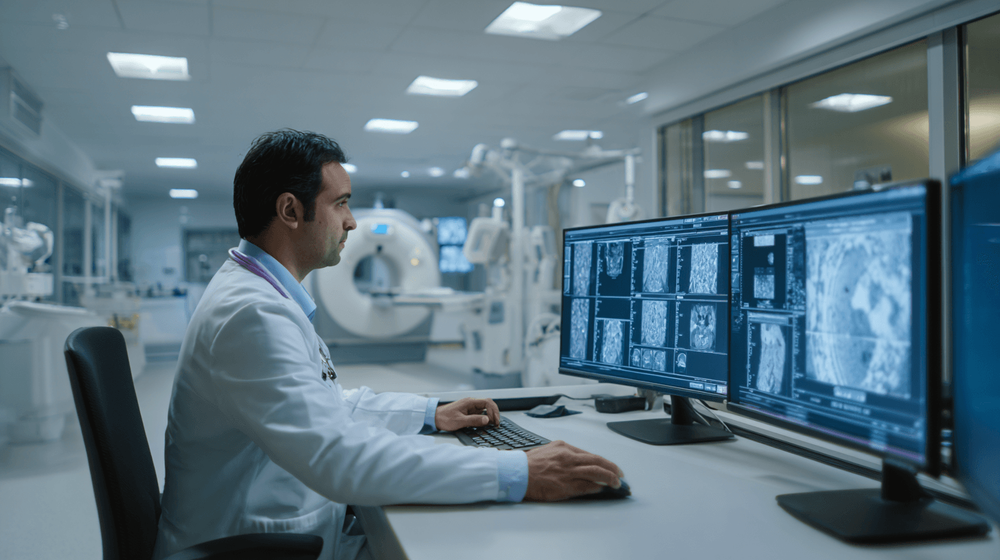
CT scanners require a comprehensive calibration sequence after relocation that includes detector calibration, tube-detector alignment verification, CT number accuracy testing using water and air phantoms, image quality assessment including spatial resolution, contrast resolution, and noise measurements, and dose verification using calibrated ionization chambers.
MRI systems require field homogeneity verification (shimming), gradient linearity testing, RF coil performance validation, and image quality assessment across all clinical pulse sequences. The OEM's field service team typically performs MRI commissioning, and the process can take two to five days depending on the system.
Ultrasound systems require transducer performance verification, image quality assessment, and Doppler accuracy testing. While less complex than CT or MRI commissioning, ultrasound calibration is still essential for maintaining diagnostic confidence.
Radiation Therapy Equipment
Linear accelerators require the most rigorous post-move commissioning of any medical device category. Beam energy verification, field flatness and symmetry testing, mechanical isocenter verification, and multi-leaf collimator (MLC) calibration must all be completed and documented before a single patient treatment can proceed. The recommissioning process typically involves both the OEM's field service team and the facility's medical physics team, and it can take one to two weeks.
Laboratory Analyzers
Clinical laboratory analyzers require post-move verification using control materials and proficiency testing samples. The laboratory must demonstrate that the analyzer produces results consistent with its pre-move performance before reporting patient results from the relocated instrument. CLIA regulations require that this verification be documented and available for inspection.
Patient Monitoring and Life Safety Equipment
Patient monitors, ventilators, infusion pumps, and defibrillators require functional testing according to manufacturer specifications after any relocation. While these devices do not require the complex calibration processes of imaging or laboratory equipment, their role in direct patient care makes post-move verification essential.
The Calibration Process
Pre-Move Baseline Documentation
The calibration process actually begins before the move. STSI coordinates with the facility's biomedical engineering team to document pre-move calibration data for every device. This baseline provides the comparison standard for post-move verification. If a device shows a shift in performance after relocation, the pre-move baseline data identifies exactly what changed and by how much.
OEM vs. In-House Calibration
Some devices require OEM-performed calibration after relocation. This is typically the case for Class III devices, imaging systems, and radiation therapy equipment where manufacturer-specific tools, software, and training are required. Other devices can be calibrated by the facility's in-house biomedical engineering team using standard test equipment and manufacturer-published procedures.
STSI coordinates the scheduling of OEM calibration visits as part of the overall project timeline, confirming that OEM technicians are available at the destination within the appropriate window after equipment delivery. This coordination prevents the common scenario where equipment sits idle for days or weeks waiting for an OEM calibration visit.
Acceptance Criteria
Every post-move calibration must be evaluated against defined acceptance criteria. These criteria come from three sources: the device manufacturer's specifications, regulatory standards applicable to the device category, and the facility's internal quality standards, which may be more stringent than manufacturer or regulatory minimums.
STSI's project documentation includes a commissioning checklist for each device that defines the post-move tests, the acceptance criteria, and the sign-off authority. The checklist ensures that no device returns to clinical service without verified calibration.
Why STSI Coordinates Post-Move Calibration
STSI does not perform calibration. That responsibility belongs to the OEM, the facility's biomedical engineering team, or qualified third-party service providers. What STSI does is coordinate the calibration process as an integrated part of the relocation project. This means scheduling OEM visits, ensuring that test equipment and reference standards are available at the destination, staging equipment for efficient commissioning workflow, and maintaining the project timeline through the commissioning phase.
The result is a seamless transition from transport to operational readiness. The device moves from STSI's care to the calibration team's care to clinical service without gaps, delays, or lost documentation.
Get a quote for your medical equipment relocation from STSI. https://spectransport.com/industries/medical-equipment
Related Services
Contact STSI
- Location: Berlin, CT - 24/7/365
- Email: STSI@Spectransport.com
- Phone: (860) 828-3286
About the Author
Nicole Mac
Director of Marketing
Specialty Transport Solutions International
Nicole Mac oversees STSI's content and communications strategy, drawing on her background in B2B logistics marketing to create resources that help IT directors, facilities managers, and procurement teams navigate complex relocation projects.
Talk to an Expert
Ready to Move? Let's Talk.
Fill out the form and our team will get back to you within 24 hours.