
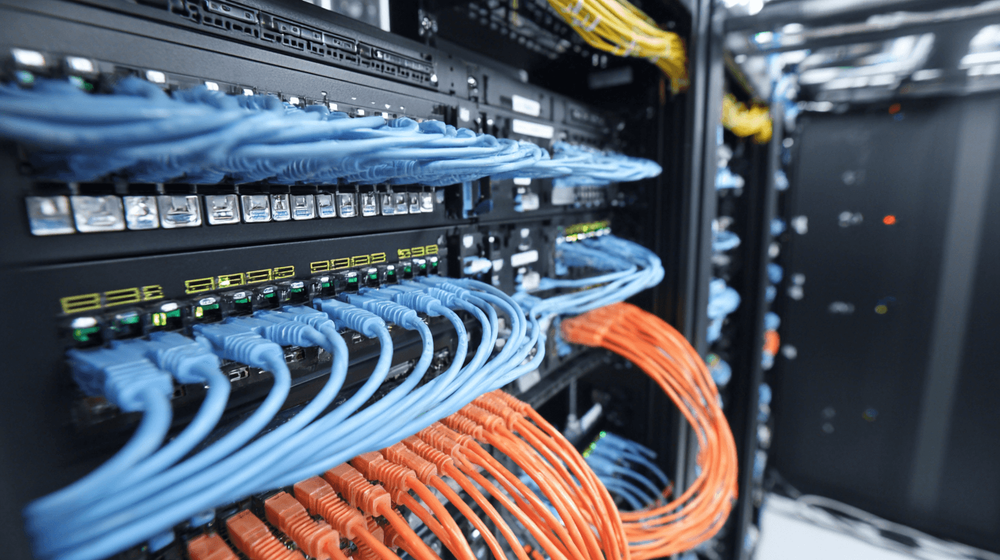
Data Center Cabling Services: What to Expect During a Migration
Cabling is the circulatory system of any data center. Every server, switch, storage array, and power unit connects to the broader infrastructure through a structured cabling plant that, when properly documented and managed, enables reliable operations. During a data center migration, that cabling plant must be documented, disconnected, transported, and re-established at the destination with zero tolerance for errors.
STSI's data center cabling services treat structured cabling as a precision component of the migration process, not a task to be delegated to the last hour of a migration weekend. Our approach begins with documentation and ends with a certified, tested cabling infrastructure at the destination facility.
Documentation Before Disconnection
The single most common cabling problem in data center migrations is inadequate documentation before disconnection begins. When cables are pulled without proper labeling and mapping, the restoration process at the destination becomes a trial-and-error exercise that extends downtime and creates configuration errors.
STSI's cabling documentation process captures every connection in the data center before a single cable is touched. This includes a physical layer diagram showing the path of every cable run from device to patch panel to distribution point, a port-mapping table that records the device, port, and cable ID for every connection, and a photographic record of every patch panel face before any cables are removed. For fiber optic runs, we document the polarity of every connector and the loss budget of every link, information that is essential for post-migration testing.
Labeling Standards
STSI implements a consistent cable labeling protocol across every migration. Every cable receives a unique label at both ends that encodes the source device, source port, destination device, and destination port. Labels are printed on durable material rated for data center environments and applied so they are readable without removing the cable from the bundle.
This labeling standard transforms the restoration process at the destination from a guessing exercise into a methodical installation that any qualified technician can execute correctly. The label at one end of a cable tells the installer exactly where the other end belongs.
Disconnection and Packing
Cable disconnection follows the documented shutdown sequence for the facility. As devices are powered down and decommissioned from the rack, their cable connections are removed in order, checked against the port-mapping documentation, and bundled according to destination rack assignment.
STSI packs cable assemblies in reusable bundles organized by destination rack. Each bundle is labeled with the destination rack ID, and the cables within the bundle are coiled correctly for their type: copper patch cables require a minimum bend radius to avoid damaging the conductors, while fiber optic cables require even more careful handling due to the fragility of the glass fiber within.
For pre-terminated fiber assemblies and high-value cable runs, STSI uses protective tubing and rigid cases to prevent connector damage during transport. Damaged fiber connectors are a common source of post-migration signal loss that forces re-termination and extends restoration time.
Coordination with the Destination Cabling Plant
In many data center migrations, the destination facility has a new or existing cabling infrastructure that must be verified before the migration's equipment arrives. STSI coordinates with the destination facility's cabling contractor to confirm that the cabling plant has been tested and certified to the appropriate standard, typically TIA-568 for copper and TIA-492 for fiber, before any equipment is installed.
Where the destination cabling infrastructure requires modification to support the incoming equipment layout, STSI coordinates that work as part of the pre-migration preparation timeline. Waiting until equipment is on the floor to discover that the cabling plant does not match the rack design is an avoidable delay.
Re-Termination and Certification
When equipment arrives at the destination, STSI's cabling team works from the pre-migration documentation to reconnect every device according to the port-mapping table. Each connection is made according to the label, verified visually, and logged in the restoration record.
After reconnection, structured cabling runs are tested using a cable certification tester calibrated to the appropriate standard. This testing confirms that every copper run meets the bandwidth requirements of the equipment it supports and that every fiber run meets the loss specifications required for reliable operation. The test results are provided to the client as part of the project documentation package.
The Business Case for Professional Cabling Management
Organizations that manage cabling documentation and disconnection themselves often discover during the restoration phase that the documentation is incomplete, the labels have fallen off, or the person who knew where the cables went is no longer available. These are not hypothetical risks, they are patterns STSI observes regularly in migrations where cabling was treated as a low-priority task.
The cost of a professional cabling approach in the context of a data center migration is marginal compared to the cost of extended downtime caused by cabling errors. With data center downtime costing an average of $9,000 per minute, a few hours of post-migration cabling confusion can easily exceed the cost of the entire project.
STSI's data center cabling services are available as a standalone offering or as an integrated component of a full data center migration engagement. Contact us at spectransport.com/industries/data-center-migration to discuss your cabling requirements.
About the Author
JP Demko
Co-founder
Specialty Transport Solutions International
JP Demko co-founded STSI in 1999 and has spent over 25 years building the company into a Fortune 500-trusted specialty logistics provider. His hands-on experience spans data center relocations, trade show logistics, and heavy equipment transport across 50+ countries, giving him firsthand knowledge of the operational challenges enterprises face.
Talk to an Expert
Ready to Move? Let's Talk.
Fill out the form and our team will get back to you within 24 hours.