
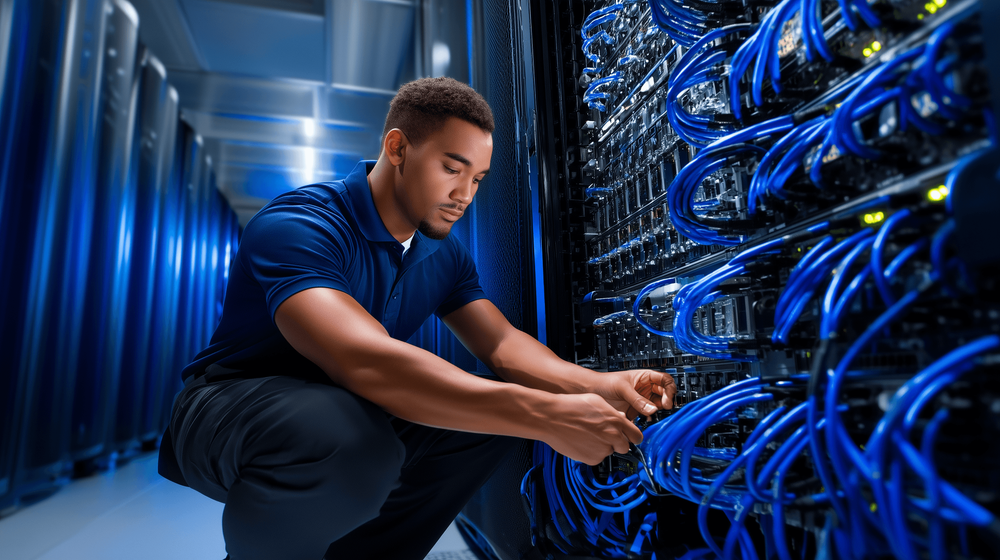
AI Data Center Infrastructure Logistics: Moving the Hardware Behind the AI Revolution
Artificial intelligence infrastructure represents the most technically demanding category of data center equipment to relocate. The weight concentrations of high-density GPU servers, the precision cooling requirements of liquid-cooled AI compute nodes, the power infrastructure designed for sustained high-density loads, and the physical fragility of the optical interconnects used in large AI clusters all create logistics challenges that require genuine specialized expertise.
STSI applies our conception-to-completion methodology to AI data center infrastructure logistics, delivering the precision and risk management that high-value, technically sensitive AI hardware demands.
What Makes AI Infrastructure Different
The defining physical characteristic of AI data center infrastructure is density. A single chassis housing eight NVIDIA H100 GPUs weighs approximately 65 pounds and generates thermal loads that require high-powered cooling when operating. A fully populated AI training rack containing multiple GPU-dense systems can weigh 2,000 pounds or more, exceeding the floor loading ratings of standard data center facilities and requiring specialized loading equipment.
The interconnect fabric connecting GPU nodes in a large AI cluster uses high-speed optical cables with polished fiber connectors that are sensitive to contamination, physical stress, and improper handling. Damage to optical interconnects in an AI cluster can degrade training performance significantly and may not be immediately apparent during the initial power-on phase after relocation.
Liquid cooling systems, now standard in many AI compute installations, introduce an additional logistics dimension: cooling distribution units with fluid connections that must be properly drained before transport, hoses and manifolds that must be protected from damage, and heat exchangers that add weight and require careful handling.
Pre-Move Documentation for AI Infrastructure
AI cluster documentation requirements exceed those of standard server relocation. The position of every GPU node in the cluster topology, the routing of every interconnect cable, the configuration of the fabric management software, and the mapping of storage volumes to compute nodes all require precise documentation before disconnection begins.
STSI's pre-move documentation process for AI infrastructure includes a topology diagram of the complete cluster, a cable-by-cable mapping of the interconnect fabric, photographs of every rack from multiple angles before disconnection, and a device-level inventory that captures firmware versions and hardware configurations. This documentation enables accurate restoration of the cluster topology at the destination.
Physical Handling for High-Density AI Hardware
High-density AI servers require specific handling precautions that standard IT equipment handling procedures do not address. The weight of GPU-dense systems requires multiple handlers and appropriate lifting equipment to safely extract from racks. Optical connectors must be capped immediately upon disconnection to prevent contamination. Liquid cooling connection points must be capped with appropriate plugs to prevent fluid residue from contaminating equipment or facilities.
STSI's handling procedures for AI infrastructure include specific protocols for optical interconnect protection, liquid cooling connection management, and weight-appropriate lifting procedures for high-density systems.
Power and Cooling Verification at the Destination
AI compute infrastructure has the highest power density requirements in the data center world. Before any AI infrastructure arrives at the destination, STSI coordinates a power and cooling verification that confirms circuit capacity for the incoming load, cooling system capacity and configuration for the density of the incoming equipment, and the status of any facility modifications required to support the AI infrastructure's physical and environmental requirements.
This destination readiness verification is a prerequisite for the physical migration execution.
The Market Context for AI Infrastructure Logistics
The global data center market is projected to grow from $22.68B in 2025 to $34.84B by 2030, driven substantially by AI infrastructure investment. Organizations building, expanding, and repositioning AI compute infrastructure will need logistics partners who can execute complex, high-value infrastructure moves with zero margin for error.
STSI is positioned to serve this market with the physical logistics expertise, risk management infrastructure, and operational discipline that AI infrastructure demands.
Contact STSI at spectransport.com/industries/data-center-migration to discuss your AI infrastructure logistics requirements.
About the Author
JP Demko
Co-founder
Specialty Transport Solutions International
JP Demko co-founded STSI in 1999 and has spent over 25 years building the company into a Fortune 500-trusted specialty logistics provider. His hands-on experience spans data center relocations, trade show logistics, and heavy equipment transport across 50+ countries, giving him firsthand knowledge of the operational challenges enterprises face.
Talk to an Expert
Ready to Move? Let's Talk.
Fill out the form and our team will get back to you within 24 hours.